
New idea
New ideas spring to my mind in the most unexpected circumstances—often when I’m not even prepared for them. Most often, they emerge at night just before I fall asleep, as my body begins to relax and I hover in that state between wakefulness and slumber—a strange state of consciousness, or perhaps the final stop before my brain shuts down for the night.
It could strike while I’m watching a horror movie or a true-crime documentary. And no, the plot has absolutely nothing to do with what I’m actually seeing on screen. It’s as if, while one side of my brain absorbs external information, the other is operating in a completely separate mode. And at some point, I realize I’m no longer really watching. Strange, isn’t it?
It is both strange and a little unsettling, because sometimes I simply don’t understand why my brain slips into creative mode in precisely that way.


From manuscript to the book
Every new idea is like a seed sprouting in the soil of the mind—but is it meant to grow? Some ideas linger in the mind for a long time, playing over day after day. A frame or a detail might shift here and there. Then it starts all over again. It spins. It burns. It blazes with an intensity that almost hurts. And if it survives this entire hurricane, the images travel from the mind onto the page.
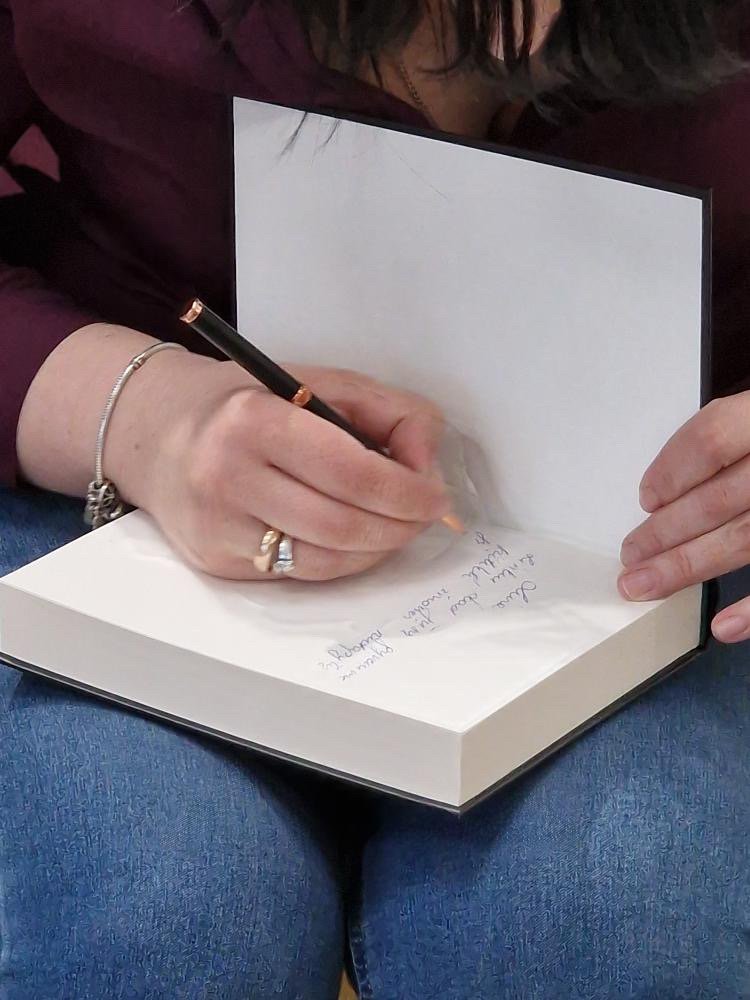
I wrote them down—once they’ve taken root—in a notebook, which I call my “Holy Book” (like a writer’s own religious text). I always write them by hand. Then the eyes analyze the words, the sentences, and the flow of the story. Usually, the story arrives complete with character names and the setting that surrounds them. During this process, my brain continues to work on the story, adding new twists, additional characters, and situations. Then, my inner voice speaks up, saying “yes” or “no”—or perhaps, “not right now.”
I have quite a few stories; some are even fully written.
The idea for my fourth book had been with me for almost ten years. After I’d submitted the manuscript of “Wolf’s Daughter,” the Lithuanian edition, at the end of May 2024, I finally turned my attention to this one. Why did I wait so long? I don’t know. There were several tries, but I would get stuck at one stage or another, and the story wouldn’t move forward. Until now.
Burnout is part of the process
Burnout is not an uncommon thing in a writer’s life, yet recovering from it is incredibly difficult. It is much like writer’s block, only a more intense form. To overcome either, I look for the causes beneath them. If the issue comes because of the story I am writing, I need to step away from it. If it arises from constantly pressuring myself to sit down and write, I need to adjust my work-rest balance. Perhaps I started the story on the wrong foot, meaning I need to find the right starting point. That is precisely why I rewrote the first chapter of “Wolf’s Daughter” more than ten times.
With each book, the process is different, and obstacles too. Finishing the manuscript to the end is unspeakably hard work. It requires time, energy, devotion, consistency, and rest.